We wanted to know: Are there digital tools that truly help children with ADHD or Autism?
Our Internal Study: 240 Parents, Surprising Results
In our team, we took the time to really listen to parents. We interviewed 240 families of neurodivergent children, many of them diagnosed with ADHD or Autism.
What stood out the most? 89% of parents told us that Smart Tales had a positive impact on their child.
Even more telling were the reasons they gave.
These parents didn’t just say “we like it.” They compared Smart Tales in detail to other apps and games their children had used. Here’s what they shared:
- “With other apps, he got angry when I had to take the tablet away. With Smart Tales, he stays calm.”
- “He doesn’t keep asking for it like he does with streaming apps. It feels more like a companion. It helps him relax, listen to stories, and learn without even realizing it.”
- “Since using it, he pronounces words better. And he listens more.”
- “He stays focused and solves the activities without getting upset. That was impossible before.”
Parents reported improvements in language, listening, problem-solving, and emotional regulation.
They also noticed that their children were able to self-regulate, did not show compulsive behaviors, and did not get irritated when it was time to stop using the device.
And the remaining 11 percent? Some did not notice major changes, while others had never used other apps before Smart Tales and couldn’t compare. Still, they described the experience as a positive one for their child.
What Science Says About Screen Time and ADHD/Autism
These observations are supported by existing research.
Several studies show that children with ADHD or Autism are more vulnerable to the negative effects of screen time, especially when exposed to fast-paced, chaotic, and unstructured content that lacks a clear educational purpose.
One study published in the Journal of Attention Disorders found that exposure to highly stimulating content can increase irritability and worsen oppositional behavior in children with ADHD¹.
This is why choosing content that is truly designed for them is so important. It needs to have a calm pace, well-balanced visual and audio input, and a clear educational goal.
¹ Becker, S. P., Sidol, C. A., & Van Dyk, T. R. (2019). Predicting Academic and Social Impairment in Adolescents with ADHD: The Role of Screen Media Usage. Journal of Attention Disorders, 23(14), 1727–1737.
🔗 https://doi.org/10.1177/1087054718799936
Why Smart Tales Works for Neurodivergent Children
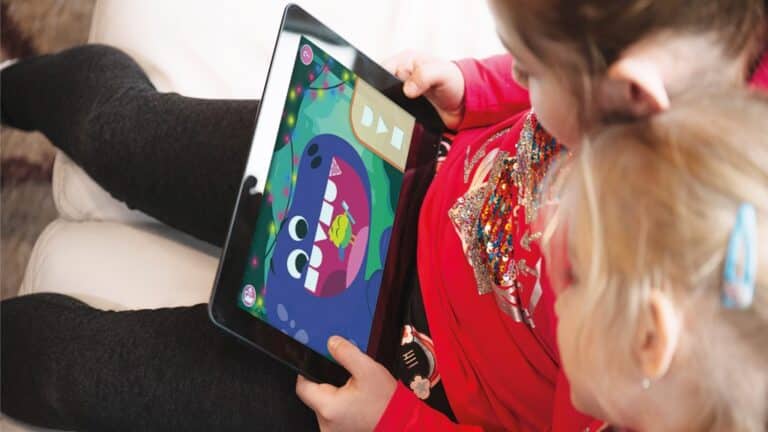
Smart Tales is not just another educational app. It was created by speech therapists and refined with educators.
It offers interactive, structured activities designed to support cognitive, language, and social-emotional development.
Key features:
- IBCCES-certified for autism-friendly design
- Over 3,000 activities in multiple languages
- Illustrated stories, logic games, and language exercises
- No ads, no toxic stimulation, no distracting content
It’s used daily by therapists, special education teachers, and clinicians as a safe, structured learning tool.
Conclusion
When we choose what our children watch, we’re not just filling time.
We’re shaping how they see the world.
With Smart Tales, we can do it in the right way.
Especially for those who need just a little more care.
FAQ: ADHD, Autism, and Screen Time
Q1: How does screen time affect children with ADHD and Autism?
Children with ADHD or Autism are more sensitive to overstimulation from screens, which can increase irritability and compulsive behaviors.
Q2: What type of screen content is best for neurodivergent children?
Calm, structured, and educational content with balanced visuals and sound works best.
Q3: Why do some children get upset when screen time ends?
Highly stimulating apps can create dependency and make transitions harder, especially for children with ADHD or Autism.
Q4: How is Smart Tales different from other apps?
Smart Tales is IBCCES-certified, ad-free, and designed by speech therapists for cognitive and emotional development.
Q5: Can educational apps improve language and focus in neurodivergent children?
Yes, parents in our study reported improvements in language, focus, and emotional regulation with structured educational apps like Smart Tales.